Wednesday, February 17, 2021

Floor Care Tips For The Winter

Article by Cleaning Maintenance Management

 https://www.cmmonline.com/articles/how-to-keep-floors-clean-in-winter-and-reduce-costs


While a matting program is an effective way to keep debris from entering a facility, regular floor maintenance is also important. The following best practices can help maintenance personnel clean and protect floors:

  • Increasing mopping frequency: A staff member should regularly mop entryways and other floor surfaces throughout the facility. This can remove salt lines from ice melt and reduce water accumulation from heavy snow and freezing rain. Use heavy-duty wet mops and microfiber mops that capture and remove moisture from floors. For spot cleaning or picking up small spills, consider a pulse mop that doesn’t require prepping a mop bucket.
  • Cleaning tools: As floors become dirtier, cleaning tools will too. Staff members should regularly change out mop water and use dual-chamber mop buckets to reduce the cross-contamination of dirty water and cleaning chemicals.
  • Cleaning out the chemical closet: The type of cleaning chemicals used can impact the floor care program’s efficacy. Use cleaning chemicals that will remove salt residue effectively while also cleaning the floor surface.
  • Maintaining periodic deep cleaning: Keeping up with regular deep cleans, especially during the winter months, can minimize the burden of daily cleaning and extend the life of floors. Deep cleaning can also restore facility floors to “like new” condition, resulting in a favorable customer outlook.

Thursday, October 15, 2020

COVID-19 AND HALLOWEEN

all information below pulled directly from the CDC website -

https://www.cdc.gov/coronavirus/2019-ncov/daily-life-coping/holidays/halloween.html 

Steps to Take when Trick or Treating

Traditional Halloween activities are fun, but some can increase the risk of getting or spreading COVID-19 or influenza. Plan alternate ways to participate in Halloween.


Make trick-or-treating safer

  • Avoid direct contact with trick-or-treaters.
  • Give out treats outdoors, if possible.
  • Set up a station with individually bagged treats for kids to take.
  • Wash hands before handling treats.
  • Wear a mask.

Wear a mask

  • Make your cloth mask part of your costume.
  • A costume mask is not a substitute for a cloth mask.
  • Do NOT wear a costume mask over a cloth mask. It can make breathing more difficult.
  • Masks should NOT be worn by children under the age of 2 or anyone who has trouble breathing

Stay at least 6 feet away from others who do not live with you

  • Indoors and outdoors, you are more likely to get or spread COVID-19 when you are in close contact with others for a long time.

Wash your hands

  • Bring hand sanitizer with you and use it after touching objects or other people.
  • Use hand sanitizer with at least 60% alcohol.
  • Parents: supervise young children using hand sanitizer.
  • Wash hands with soap and water for at least 20 seconds when you get home and before you eat any treats.

Tuesday, September 22, 2020

Returning To Work

Protect yourself and others in the workplace

Stay home when needed

  • If you have or think you have symptoms or have tested positive for COVID-19, stay home and find out what to do if you are sick and find out when you can be around others.
  • If you are well, but you have a sick family member or recently had close contact with someone with COVID-19, notify your supervisor and follow CDC recommendation precautions.

Monitor your health

  • Be alert for symptoms. Watch for fever, cough, shortness of breath, or other symptoms of COVID-19.
    • This is especially important if you are running essential errands, going into the office or workplace, and in settings where it may be difficult to keep a physical distance of 6 feet.
  • Take your temperature if symptoms develop.
    • Don’t take your temperature within 30 minutes of exercising or after taking medications that could lower your temperature, like acetaminophen.
  • Follow CDC guidance if symptoms develop.

Wear a mask

  • Wear a mask in public settings where staying 6 feet apart (about two arms length) is not possible. Interacting without wearing a mask increases your risk of getting infected.
  • Wearing a mask does not replace the need to practice social distancing.

Social distance in shared spaces

  • Maintain at least 6 feet of distance between you and others. COVID-19 spreads easier between people who are within 6 feet of each other.
    • Keeping distance from other people is especially important for people who are at increased risk for severe illness, such as older adults and those with certain medical conditions.
    • Indoor spaces are more risky than outdoor spaces where it might be harder to keep people apart and there’s less ventilation.
  • Avoid close contact with others on your commute to work, if possible. Consider biking, walking, driving either alone or with other members of your household. Learn how to protect yourself when using trans to commute to work.

Wash your hands often

  • Wash your hands often with soap and water for at least 20 seconds or use hand sanitizer with at least 60% alcohol if soap and water are not available. If your hands are visibly dirty, use soap and water over hand sanitizer.
  • Avoid touching your eyes, nose, and mouth if you haven’t washed your hands.

Cover your coughs and sneezes

  • Remember to cover your mouth and nose with a tissue when you cough or sneeze, or use the inside of your elbow. Throw used tissues into no-touch trash cans and immediately wash hands with soap and water for at least 20 seconds.
    • If soap and water are not available, use hand sanitizer containing at least 60% alcohol.

Avoid sharing objects and equipment

  • Avoid using other employees’ phones, desks, offices, or other work tools and equipment, when possible. If you cannot avoid using someone else’s workstation, clean and disinfect before and after use.

Clean and disinfect frequently touched surfaces and objects

  • Clean and disinfect frequently touched objects and surfaces, like workstations, keyboards, telephones, handrails, and doorknobs. Dirty surfaces can be cleaned with soap and water before disinfection.
  • To disinfect, use EPA- registered disinfectants.
***ARTICLE from  https://www.cdc.gov/coronavirus/2019-ncov/daily-life-coping/returning-to-work.html

Wednesday, July 15, 2020

Reopening Schools: The Challenge Ahead

school disinfecting

The task
The process
The stakes

Normally at this time of year, 55 million students and 7 million teachers, staff, and administrators would be preparing for a new school year in the United States. 2020 is not like other years, however, as the impact of coronavirus has turned America’s back-to-school season into one of uncertainty.
Across the nation, school districts are contemplating if, how, and when to reopen schools. Administrators are weighing information from various sources: local and state governments, state health organizations, state departments of education, and the U.S. Centers for Disease Control and Prevention (CDC), trying to discern the appropriate course of action for schools.
What’s at stake? In June, a group of state education leaders were summoned to a congressional meeting in Washington, D.C. to discuss school reopening in the fall. “Any decision we make has significant costs…we must keep kids safe and we must keep students educated,” said Penny Schwinn, Tennessee’s education commissioner.
The tension created by these priorities—safety and education—makes school reopening decisions incredibly difficult. Preventing the spread of COVID-19 is a priority, but so is the education of students. How can both objectives be achieved? What will be the costs of reopening compared to those of remaining closed?
The American Academy of Pediatrics issued a statement in late June strongly advocating that all policy considerations for the coming school year should start with a goal of having students physically present in school. The association stated, “there is already evidence of the negative impacts on children because of school closures in the spring of 2020,” noting not only educational deficits, but also negative impacts on student health and wellness.
The questions surrounding the reopening of schools are front and center in the minds of educators, administrators, and parents. For schools that plan to reopen, the focus is on custodial services directors and their crews who are charged with keeping facilities clean, safe, and healthy. Can it be done?
Few public environments are more challenging to clean and disinfect than a school, where kids are close to one another and touch things constantly. The same can be said for school buses, which one cleaning expert described as an environment filled with “fingerprints and snot.” The enormity of the task is revealed in the number of conversations now taking place between school housekeeping managers and cleaning services.
Steve Morgan owns ServiceMaster Recovery Management in Atlanta. He has worked with school districts for 15 years but has never experienced the volume of calls he has fielded this year from schools that need either services or advice.
“I had two calls from schools just this morning,” said Morgan in a recent interview. “We will potentially be working with 30 or more school districts in the fall. We quoted one school system last week that has 4 million square feet of space to clean. The need is enormous.”
Morgan said that not all schools want to hire additional help, some just need advice or a professional option should their own staff become overwhelmed. The advice he offers free of charge. Many of the questions involve how to reopen a school that shut down suddenly in March and has remained closed
“In a lot of cases, schools just sent everyone home when they closed in March. They locked the doors and haven’t been back since,” said Morgan. “The students and teachers left behind clothing, notebooks, food items, garbage…a little of everything. The decision of what to do about those things has to be addressed, then there are decisions about sanitization; can they do it themselves or do they need help?”
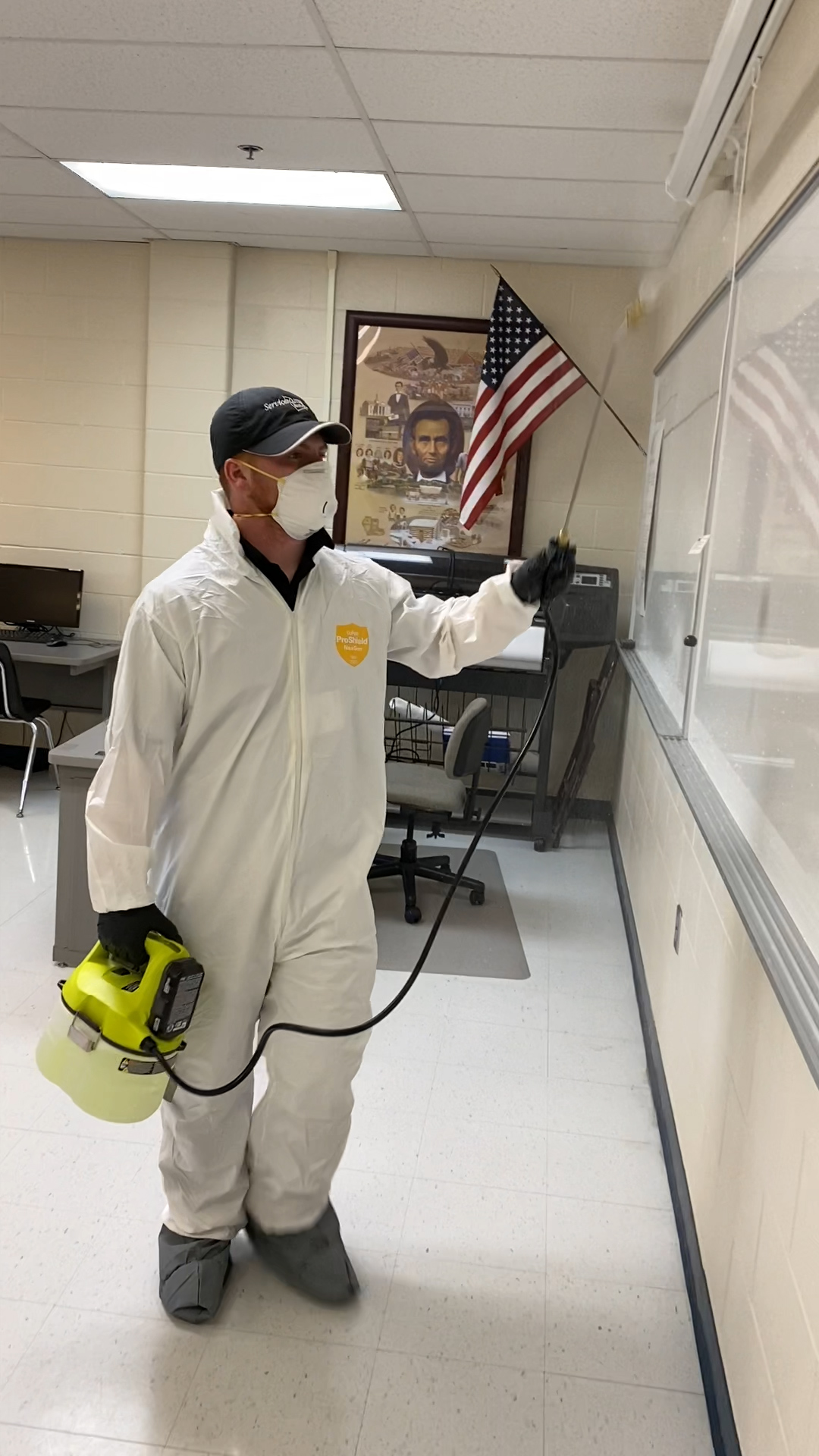
School disinfection. (Image courtesy of ServiceMaster Restore)
Many schools across the country will make decisions based on the risk of COVID-19 in their district. In Georgia, for example, the Georgia Department of Education has produced a reopening plan based on three levels of risk determined by the number of cases in each community. Level 1 is “low/no spread,” which means there is a low coronavirus risk and schools can reopen with normal precautions. Level 2 is “minimal/moderate spread,” which is an elevated risk. For districts with a minimal to moderate number of cases, schools are encouraged to adopt elevated mitigation and distancing strategies. Level 3 is the highest level of risk, “substantial spread,” with the recommendation that schools provide remote learning for as long as the high level of cases remain evident in their district.
If schools do open this fall, as many already plan to do, what cleaning protocols will be necessary to maintain a reasonable level of safety? Most will likely take a two-pronged approach: proactive disinfecting and secondary contact cleaning.
According to Morgan, some schools will consider it necessary to do a thorough deep cleaning and sanitization of all surfaces before school reopens. This proactive cleaning is both a practical idea and also a hedge against liability. Schools will want to assure parents and teachers that the school environment has been sanitized and is safe for students, but that’s just the start. They also will need to follow up with daily cleaning to prevent reinfection.
For deep cleaning, some schools may want professional help from an experienced cleaning service that uses EPA-registered products and cleaning techniques, and perhaps even electrostatic sprayers that assure more thorough coverage of all surfaces. Crews will first clean the facility thoroughly to remove dirt and grime, then sanitize all touchable surfaces making
sure that disinfecting products achieve adequate dwell times to kill bacteria and deactivate viruses.
Once teachers and students return to class, every room in the school could be potentially reinfected. It’s up to the individual school system to determine the level of cleaning it will do daily to help prevent the spread of coronavirus.
Daily spot cleaning by custodial crews will be essential to help break the chain of infection. Wiping high-touch surfaces with disinfecting cleaners will be a priority, but it is important that cleaning staff know the proper cleaning techniques, e.g., wiping only in one direction or in an “S” motion to prevent spreading germs, using microfiber cloths and mops to capture dust particles, and following product label requirements for application and adequate dwell times.
Some schools simply do not have enough staff to do spot cleaning multiple times a day and then provide a more thorough cleaning at night. In such cases, they may turn to outside vendors to augment their staff. Expect school administrators to educate themselves on cleaning and disinfecting before they interview outside janitorial services so they can ensure the company they hire is experienced and properly trained to do the job well.
Maintaining a clean, safe, and healthy environment for students also requires coordination and communication. Frequent, perhaps daily, inspection of the facility and written reports of cleaning procedures will help make sure everyone is focused. Check with your custodial team or custodial service provider (if you have one) daily to review their work and discuss potential issues. Remember the stakes are high when it comes to keeping schools clean, safe, and healthy. Attention to detail goes a long way.


ARTICLE from Cleaning & Maintenance Management - https://www.cmmonline.com/articles/reopening-schools-the-challenge-ahead

Friday, June 26, 2020

What Time Of The Day Should We Clean

What time of the day is the best time to clean?


Is the morning better or is the nighttime better?

What are the benefits of cleaning at each time?

Morning = Fresh start to clean and not be bothered.

Night = Nothing to be dirtied after cleaning and can have the location fresh for in the morning.


Article information from https://www.csginc.com/posts/night-and-day-cleaning/

Friday, May 29, 2020

Rats Taking Over

The pandemic has affected many aspects of modern living, from garbage and recycling pick up to public transportation.  Add pest control to the list.
The U.S. Centers for Disease Control and Prevention (CDC) warns that as a result of closed restaurants and other businesses, rats may be agressive as they hunt for new sources of food. Environmental health and rodent control programs should be prepared for an increase in calls. The CDC recommends that facilities seal all possible entries (rats can enter a building through a half-inch opening) and make sure garbage bins are tightly closed.

CLEANING MAINTENANCE MANAGEMENT

Tuesday, April 28, 2020

Improving Disinfection Outcomes with Electrostatic Technologies

It’s becoming more difficult for facilities to stay ahead of today’s rising public health threats and increasing demands for higher levels of disinfection. Managers and service providers are challenged with improving outcomes, yet in a limited timeframe without increasing budgets or staff. The advent of advanced electrostatic technologies offers facilities new ways to achieve greater efficiencies and better outcomes.

Newfound efficiency

Traditional disinfection methods can leave a large percentage of surfaces untouched. However, when electrostatics are used in place of—or in addition to—wipes, trigger sprayers, or mops, a single team member can disinfect the same area that normally required a staff of five. This newfound efficiency enables facilities to increase disinfection frequency, which is crucial to preventing the spread of emerging viral pathogens.
Electrostatic sprayers also achieve three times the coverage of a traditional spray bottle due to positively charged disinfectant droplets, which magnetically attract to and wrap around target surfaces. Not only can users expedite the disinfection processes, they also can eliminate virtually all infectious fungi, viral particles, and bacteria from every surface.

Electrostatic options

Over the last several years, electrostatic sprayer technologies have evolved significantly and are now easier to use for disinfection purposes. Types of equipment range from handheld sprayers and self-contained backpacks  to variations of rolling cart systems, or a combination thereof. Some versions are battery-powered, while others are corded, but both are designed to positively charge the liquid solution. Battery-powered sprayers remove the potential for cord-related accidents and allow freedom of movement without being tethered to an outlet. In the past, users questioned whether batteries were strong enough to deliver consistent electrostatic application compared to cords connected to a power source. However, today’s high-performance, portable sprayer technologies are more than powerful enough to coat every surface completely and evenly.
When comparing electrostatic equipment options, ensure they are ETL or UL certified by Nationally Recognized Testing Laboratories (NRTL) to confirm they meet the U.S. Occupational Safety and Health Administration(OSHA) safety standard requirements. Also make sure the equipment comes with clear guidelines to help staff use the system responsibly and with the proper disinfectant chemistries.

Electrostatic merits

Although electrostatic disinfection is on the rise, users are just beginning to realize its merits for improving disinfection outcomes. Many facilities are already seeing dramatic drops in labor costs and expenses due to faster disinfection times and triple surface coverage per ounce. In a matter of minutes, workers disinfect entire areas with just a quick pass of the electrostatic device over potentially contaminated surfaces.
Additionally, many safety benefits are associated with electrostatic disinfection processes. Applying chemicals in a more uniform and controlled manner removes the dangers of overuse and reduces waste and chemical use by as much as 60% per square foot.

Friday, April 10, 2020

Let's Show COVID-19 WHO IS BOSS!

During this recent outbreak, people are panicking about keeping everything clean, especially their workplaces.

Your commercial cleaning business has now become a necessity! Don’t let your business fail because you cut back on your advertising budget! This is the best time to start reminding your community that you can help.

Call someone you can count on 847-885-8181.

Tuesday, February 18, 2020

Expediting the Drying Cycle

Learn here and how the three aspects of drying can be most advantageous based on a timeline.


When it comes to water damage, understanding evaporation and how drying equipment is used can be beneficial for facility managers who do water restoration.


Below are things you must be aware of:

  1. Humidity
  2. Airflow
  3. Temperature
  4. Maximizing equipment efficiencies 


Article by IIRC - David Oakes

Friday, January 24, 2020

Workshop Attendees Fight MRSA With Training and Exercises

Members of a school’s volleyball team came down with Methicillin-resistant Staphylococcus aureus (MRSA), so school officials called in bio-response specialists to track the source of the infection and disinfect the campus. 
After the specialists cleaned and disinfected the volleyball courts, the locker rooms, and the showers, more team members came down with MRSA. So, the specialists turned their attention to the campus fitness center. After a thorough disinfection, the MRSA cases among the team ceased.
This scenario, although realistic, was actually an exercise in which attendees of a bio-response fundamentals training workshop presented by the GBAC, a division of ISSA, got the chance to try out what they learned. The all-day workshop, held this week at ISSA headquarters in Northbrook, Illinois, was created for individuals and facility service professionals seeking information and training on responding to disease outbreak situations, gaining skills in forensic cleaning and professional disinfection, and understanding the important role the cleaning industry has in public preparedness for infectious disease outbreaks.
Following a morning of training on germs; personal protective equipment (PPE); the methods and differences of cleaning, sanitizing, and disinfecting; and an overview of cleaning and disinfecting tools and equipment, attendees were ready to put their knowledge to test in the afternoon. They donned the appropriate PPE: paper coveralls, respirators, full-face shields, disposable gloves, shoe covers, hair covers, and even a helmet equipped with a cooling HEPA filter. They chose their microbial weapons—microfiber cleaning tools and a variety of electrostatic disinfecting sprayers available in hand-held, backpack, and wheeled cart models—and set off for the ISSA fitness center, which was masquerading as the volleyball team facility.
As GBAC trainers prompted them to start from the cleanest surface and make their way to the dirtiest, the trainees used their sprayers to mist the ceiling first, then the walls, all the fitness equipment, then lastly, the floors. “Gymnasiums are hard to disinfect as there are a lot of moving parts, a lot of areas for germs to hide,” said GBAC board member Dr. Gavin Macgregor-Skinner.
Staff reminded them to follow disinfectant dwell times, so if a product required a 10-minute dwell time and it was dry in seven minutes, it was best to rewet the surface.
After the class participants finished disinfecting the room, they made sure not to contaminate the room again with their equipment by cleaning the wheels and cord of a pull-along disinfectant sprayer. They also took care not to contaminate themselves, by following earlier instructions on the correct removal of disposable gloves as well as the rest of their PPE.  “You can practice removing disposable gloves while you are at home, watching tv,” Macgregor-Skinner suggested.
When one participant realized he had torn his coveralls, Macgregor-Skinner explained how he always carries duct tape for such emergencies. “Tears are realistic. Duct tape any rips; duct tape is your best friend,” he said.
Prepare your professional cleaning and restoration staff to become microbial warriors.


Article by Cleaning and Maintenance Management.

Monday, January 6, 2020

Corners and Crevices: The Nastiest Restroom Areas


True or false: The toilet seat is the dirtiest part of the restroom.
Regardless of what patrons may think, the toilet seat—unless visibly soiled—is probably cleaner than many other surfaces in the restroom and is a less-likely source of cross-contamination compared to other high-touch point areas in the toilet stall, such as the flush handle, stall door handles, or handicap grab bar.
From urine- and mold-prone surfaces to tough-to-clean stains, here we explore some of the grossest and most difficult-to-clean areas of the restroom.

Gross Area No. 1: The Toilet Bowl

When cleaning the toilet, the focus should always start below the toilet seat, according to infection control expert J. Darrel Hicks, as it’s important to clean from the dirtiest area to the cleanest.
To get started, take a compact mirror and use it to look below the rim where the toilet’s water ports are located. This is the area that passes water when someone flushes the toilet. When you do this, you will probably see a buildup of mineral deposits, stains, or even black bacteria. Buildup like black bacteria is not only a source of germs and decay, but it can cause odor issues in your restroom, as well.
Cleaning tips: When cleaning the toilet bowl area, make sure the bowl brush remains inside the toilet until you are done cleaning, Hicks says. Using the brush to clean the outside of the toilet will only bring more germs onto the toilet seat and outer bowl. If you are trying to remove a stubborn stain like hard water or rust, a pumice stick may come in handy. You may also want to try an acid-based bowl cleaner or a calcium, lime, and rust remover.

Gross Area No. 2: Surfaces with Bodily Fluids

While this gross area is pretty vague and can apply to a variety of restroom surfaces, the rule of thumb is pretty similar across the board: Leaving bodily fluids to rest on surfaces or in receptacles can lead to more bacteria growth and putrid odors. This applies to feminine hygiene receptacles—a commonly missed area, Hicks says—urinal mats and screens, or any other surface that is prone to urine, fecal, or blood exposure.
Cleaning tips: Clean early and often. Change feminine hygiene receptacles at least once daily, with increased frequency depending on your restroom’s foot traffic. Employees should check to make sure the bags have not leaked, and clean the inside of the receptacle if necessary.
Change urinal mats and screens at least every two weeks. When replacing the mats and screens, write a date on when they next need changing. This will help to remind employees when it’s time to make a switch and provide a quality assurance checkpoint for supervisors during inspections.
Of course, when cleaning any of these areas, make sure your employees have access to and are trained to use proper personal protective equipment, such as gloves.

Gross Area No. 3: Grout

Grout is prone to developing mold and other bacteria because of its exposure to moisture, whether from standing water, vapor in the air, or urine. This can lead to discoloration and odor control issues among other problems.
Cleaning tip: Avoid using mopping systems that leave moisture behind in the grout lines to prevent mold from coming back. Additionally, apply steam to the grout while using a brass wire brush to remove the mold. Last, improve air circulation in the restroom and any shower areas to help encourage drying of wet surfaces.


Article by Cleaning and Maintenance Management

Thursday, December 12, 2019

Some good news for a change regarding health care acquired-infections (HAIs)—a report from the U.S. Centers for Disease Control and Prevention found the incidences of three common infections were down in 2018.
Acute-care hospitals reported the number of C. difficile infections were down by 12% since last year, central line-associated bloodstream infections were down by 9%, and catheter-associated urinary tract infections were down by 8%. Most U.S. states (44) improved their performance for at least three HAIs between 2017 and 2018.
However, this decrease did not apply to all HAIs. There were no changes reported in the number of cases of ventilator-associated infections, surgical site infections, or Methicillin-resistant Staphylococcus aureus (MRSA) between 2017 and 2018.


Article by Cleaning & Maintenance Management

Tuesday, November 26, 2019

How to Prepare your floors by Winter


Winters in the Chicagoland area bring ice, snow, and sleet. To keep roads and walkways clear, many of us rely on sand, rock salt and/or ice melt which people then track inside, creating floor care and maintenance issues. To combat these issues, it’s important to look at the amount and type of hard flooring as well as what’s being tracked inside the building in order to determine the best floor care methods.

Evaluate Floor Cleaning Chemicals

First off, we must look at the product(s) used to maintain the outside areas. Sand requires extra sweeping and vacuuming each day. Where salt and calcium chloride are used, we often switch floor-cleaning chemicals in the winter months at locations with high foot traffic. The cleaning product we use neutralizes and counteracts the effects of calcium chloride and removes the whitish residue from floors.

Consider Flooring Materials

Next, let’s consider the type of floor that needs to be cleaned. Vinyl composite tile, also known as VCT, is an inexpensive floor that is used in many facilities. VCT is always waxed to protect the floor and give a glossy finish. Salt and calcium residue as well as water from melting snow can make VCT floors very slippery. For safety reasons as well as easier upkeep, we recommend walk-off mats at each entrance to minimize the amount of moisture that gets onto the floor. (It’s important to note that vacuums can be quickly damaged by moisture so care must be taken when cleaning walk-off mats.) Another popular flooring is quarry tile, which typically is a textured surface. Even though quarry tile is slip-resistant, we suggest placing wet-floor signs in visible areas every time it rains, sleets or snows.

Use the Best Cleaning Process

Finally, the best way to clean a large common area or open floor areas is with an automatic floor scrubber, or autoscrubber, as referred to in the industry.  An autoscrubber is a battery-powered machine that puts down water, cleans with a brush, and then vacuums with squeegee blade. These machines require a financial investment of several thousand dollars but offer labor savings over time. It’s also important to note that autoscrubbers use fewer chemicals than other methods as the machine, not the cleaning chemicals, does most of the work.


Article by Cleaning & Maintenance Management

Thursday, November 14, 2019

Avoiding Cross Contamination in Your Commercial Cleaning Company

When an employee comes to work sick, that illness can quickly make its way around the office. Cleaning crews can be part of the problem or the solution, depending on how well they understand and address cross-contamination.
Cross-contamination is when germs move between people in shared spaces. It most often happens when a sick person touches something and then someone else touches the same contaminated surface. It can also happen unintentionally during the cleaning process, like when a janitor cleans a toilet and then washes a countertop with the same cloth.
If your janitorial crew plays a part in the spread of viruses and bacteria in a building, it can result in real losses for your clients and, potentially, cancelled contracts for your business.
  • In office buildings, illness has costs associated with paid sick days, healthcare, and decreased productivity.
  • In schools and healthcare settings, illness can affect government funding tied to absentee rates or healthcare-associated infections.
  • In food-service settings, a salmonella or e-coli outbreak can seriously damage a company's reputation and bottom line.
Make sure your contract cleaning company is part of the solution by using these best practices to prevent cross-contamination.

Avoid Cross Contamination with Smart Processes

Outline a clear cleaning process for your employees so they don't accidentally spread germs or miss any areas of a room. Cleaning from top to bottom allows gravity to move anything not captured in the cleaning tool to the floor so it is removed in the final step.
Here is an example of a simple process:
  • First, wipe down all surfaces with cleaning solution.
  • Next, use spray disinfectant on high-touch areas, like desks, phones, door knobs and push plates, elevator buttons, counters, railings, and all bathroom surfaces. Follow the manufacturer's instructions for appropriate dwell time before wiping off the product.
  • Finally, clean the floor, mopping or vacuuming from the farthest inside point of the room back out the door, throwing away your gloves as you leave the room.
Don't take the common mistake of cleaning multiple areas with the same tools or supplies. Bacteria and viruses can take up residence on things like cleaning cloths or mop heads, which can then easily spread those things around if they are used again and again.
Train your cleaning crews to segregate equipment—having a set of color-coded microfiber cloths and mops used exclusively in the restroom or lunchroom, etc. Also, store cleaning tools using the same method of separation so a kitchen mop doesn't end up touching a bathroom mop.

Avoid Cross Contamination with Color Coding

You can't always be on-site with your cleaning crews to check that they are properly segregating equipment. Plus, janitorial companies often have employees for whom English isn't their native language. Implementing a color-coding system can address both of these issues.
Choose products that come in several colors (most commonly red, yellow, blue, and green).
Color coding can prevent spreading contaminants by using the wrong tool in the wrong area. Janitors can see at a glance what should be used where, regardless of language barriers.
Color coding can also be applied to cleaning equipment such as mop handles and colored mop buckets. Of course, a system is only as strong as the training behind it. Be sure that everyone on your team knows and understands the color system. In the case of language issues, consider using pictograms in addition to text to explain the colors.

Avoid Cross Contamination by Switching to Microfiber

Ordinary cleaning cloths are often made of large cotton fibers. Microfiber cloths, on the other hand, are typically made from polyester or polyester blends and have fibers that are smaller than a strand of silk.
When a traditional mop or cloth touches a surface, it becomes contaminated. As soon as you put it back into the water or move it around the room, it contaminates the water and the next surface.
The unique construction of microfiber allows it to attract up to 99% of particles—about three times more than cotton. It has a positive charge (like a magnet), which attracts dirt and germs, and is super porous so it holds the particles tightly. In short, microfiber picks up and removes contaminants rather than redistributing them around the room like cotton.
Although it will require a financial investment, switching to microfiber wet and dry mops, cleaning cloths, and dust wands will vastly improve the quality of your work. It will more successfully remove illness-causing pathogens and greatly reduce your cross-contamination risk.

Look at Other Tools

There are other tools that can also help reduce cross-contamination:
  • A flat mop with a built-in tank that squeezes out the water is a better option than a traditional mop with a basic bucket. It holds dirty water, increasing the risk of spreading contaminants around.
  • Spray-and-vac systems provide an alternative to mopping. It dispenses fresh cleaning solution for each application, then sucks up the solution. This eliminates the spread of contaminants via a mop head.
  • HEPA-filtered vacuum cleaners capture 99.9% of particles, far more than traditional vacuums.
  • Choose certified green cleaning products over hazardous chemicals whenever possible to maintain a healthier and safer environment. 

Preach Hand Hygiene

Proper hand hygiene is the simplest and most important way of preventing cross contamination. Teach your staff to wash their hands properly and at the appropriate times (after using the washroom, eating, touching a surface with bare hands, etc.).
What's more, talk to the facility owner or manager about how you can help them promote hand washing among building occupants. Ideas include offering hand hygiene supplies (soap, towels, hand sanitizer) and providing signage that encourages handwashing in every restroom, lunchroom, and breakroom.
The most essential element of a program to prevent cross contamination is training. Make sure everyone knows your processes, tools, and expectations. Ask supervisors to keep a close on workers in the field to be sure best practices are being used on a daily, ongoing basis. Revisit your training on a regular (at least annual) basis to keep the issue top-of-mind.


Article by Cleaning & Maintenance Management.

Tuesday, November 5, 2019

3 Technologies to Eliminate Germs from High-Touch Surfaces


Contamination of high-touch surfaces is responsible for the transmission of pathogens in various settings. Its impact is most severe in school and health care facilities and is one reason why health care-associated infections (HAIs) continue to be such a serious problem.
Although the number of HAIs has been steadily decreasing in the United States, "on any given day, about one in 31 hospital patients has at least one health care-associated infection," according to data from the U.S. Centers for Disease Control and Prevention.


In school environments, contaminated surfaces not only spread disease within classrooms but also can spread infections, such as influenza, within a community.
The professional cleaning industry plays a crucial role in stopping the spread of infection, but before cleaning staff can eliminate pathogens, they must first find them. In the past, laboratory technicians would swab surfaces and use a petri dish culture to confirm the presence of pathogens. The findings would not be available for two to four days, giving the germs opportunity to sicken more people.
Technological advances are providing quicker methods to locate pathogens, enabling the professional cleaning industry to better meet its goal of protecting human health. While these technologies have drawbacks, they do show promise.

Prove Contamination With Paper Stickers

In May 2019, a report in the Journal of the American Society for Microbiology found that paper stickers can be an effective tool to determine if contamination exists on surfaces. For up to seven days, researchers placed stickers on multiple high-touch surfaces in food service locations. After analyzing the stickers, the researchers found they revealed a considerable buildup of contamination on these surfaces.
Paper stickers are an inexpensive, simple, and effective method to locate contamination. However, the analyzation process takes valuable time, and the stickers only pick up pathogens on the area tested, not the surrounding area.

ATP Marks the Spot

Although adenosine triphosphate (ATP) has been in use since the 1930s, it was first introduced to the cleaning industry about a decade ago. ATP monitoring systems detect living cells on a surface. Users simply swab a surface then place the swab inside the ATP unit. Results are usually available in about 20 seconds.
While ATP does not reveal which specific pathogens are on a surface, it serves as a red flag that they may be present. Cleaning professionals use ATP to test a surface before cleaning and again after cleaning to determine cleaning effectiveness. However, like paper stickers, ATP only detects pathogens on the specific areas tested.

Imaging Paints a Wide Picture

The health care industry, one of the first industries to use imaging technology, found it useful to find the growth of cancer and other abnormalities in the human body. In the professional cleaning industry, workers use imaging technologies in schools, food service facilities, and health care settings to take pictures of a wide area. These pictures indicate if pathogens are present based on the color, intensity, and concentration of images shown. 

Taking Responsibility for Infection Control

While the obvious reason for using technologies like the ones mentioned above is to quickly find and remove pathogens, cleaning professionals should be aware that there is something much bigger at play here.
Many germs are developing into superbugs that spread diseases immune to the medications used to treat them. Pharmaceutical companies have set a limited amount of time and money in developing new antimicrobials. This puts greater responsibility on the cleaning industry's shoulders to find and proactively eradicate harmful pathogens. With these technologies and the implementation of effective cleaning methods, we will be up to the challenge.


Article by Cleaning & Maintenance Management.