Wednesday, July 15, 2020

Reopening Schools: The Challenge Ahead

school disinfecting

The task
The process
The stakes

Normally at this time of year, 55 million students and 7 million teachers, staff, and administrators would be preparing for a new school year in the United States. 2020 is not like other years, however, as the impact of coronavirus has turned America’s back-to-school season into one of uncertainty.
Across the nation, school districts are contemplating if, how, and when to reopen schools. Administrators are weighing information from various sources: local and state governments, state health organizations, state departments of education, and the U.S. Centers for Disease Control and Prevention (CDC), trying to discern the appropriate course of action for schools.
What’s at stake? In June, a group of state education leaders were summoned to a congressional meeting in Washington, D.C. to discuss school reopening in the fall. “Any decision we make has significant costs…we must keep kids safe and we must keep students educated,” said Penny Schwinn, Tennessee’s education commissioner.
The tension created by these priorities—safety and education—makes school reopening decisions incredibly difficult. Preventing the spread of COVID-19 is a priority, but so is the education of students. How can both objectives be achieved? What will be the costs of reopening compared to those of remaining closed?
The American Academy of Pediatrics issued a statement in late June strongly advocating that all policy considerations for the coming school year should start with a goal of having students physically present in school. The association stated, “there is already evidence of the negative impacts on children because of school closures in the spring of 2020,” noting not only educational deficits, but also negative impacts on student health and wellness.
The questions surrounding the reopening of schools are front and center in the minds of educators, administrators, and parents. For schools that plan to reopen, the focus is on custodial services directors and their crews who are charged with keeping facilities clean, safe, and healthy. Can it be done?
Few public environments are more challenging to clean and disinfect than a school, where kids are close to one another and touch things constantly. The same can be said for school buses, which one cleaning expert described as an environment filled with “fingerprints and snot.” The enormity of the task is revealed in the number of conversations now taking place between school housekeeping managers and cleaning services.
Steve Morgan owns ServiceMaster Recovery Management in Atlanta. He has worked with school districts for 15 years but has never experienced the volume of calls he has fielded this year from schools that need either services or advice.
“I had two calls from schools just this morning,” said Morgan in a recent interview. “We will potentially be working with 30 or more school districts in the fall. We quoted one school system last week that has 4 million square feet of space to clean. The need is enormous.”
Morgan said that not all schools want to hire additional help, some just need advice or a professional option should their own staff become overwhelmed. The advice he offers free of charge. Many of the questions involve how to reopen a school that shut down suddenly in March and has remained closed
“In a lot of cases, schools just sent everyone home when they closed in March. They locked the doors and haven’t been back since,” said Morgan. “The students and teachers left behind clothing, notebooks, food items, garbage…a little of everything. The decision of what to do about those things has to be addressed, then there are decisions about sanitization; can they do it themselves or do they need help?”
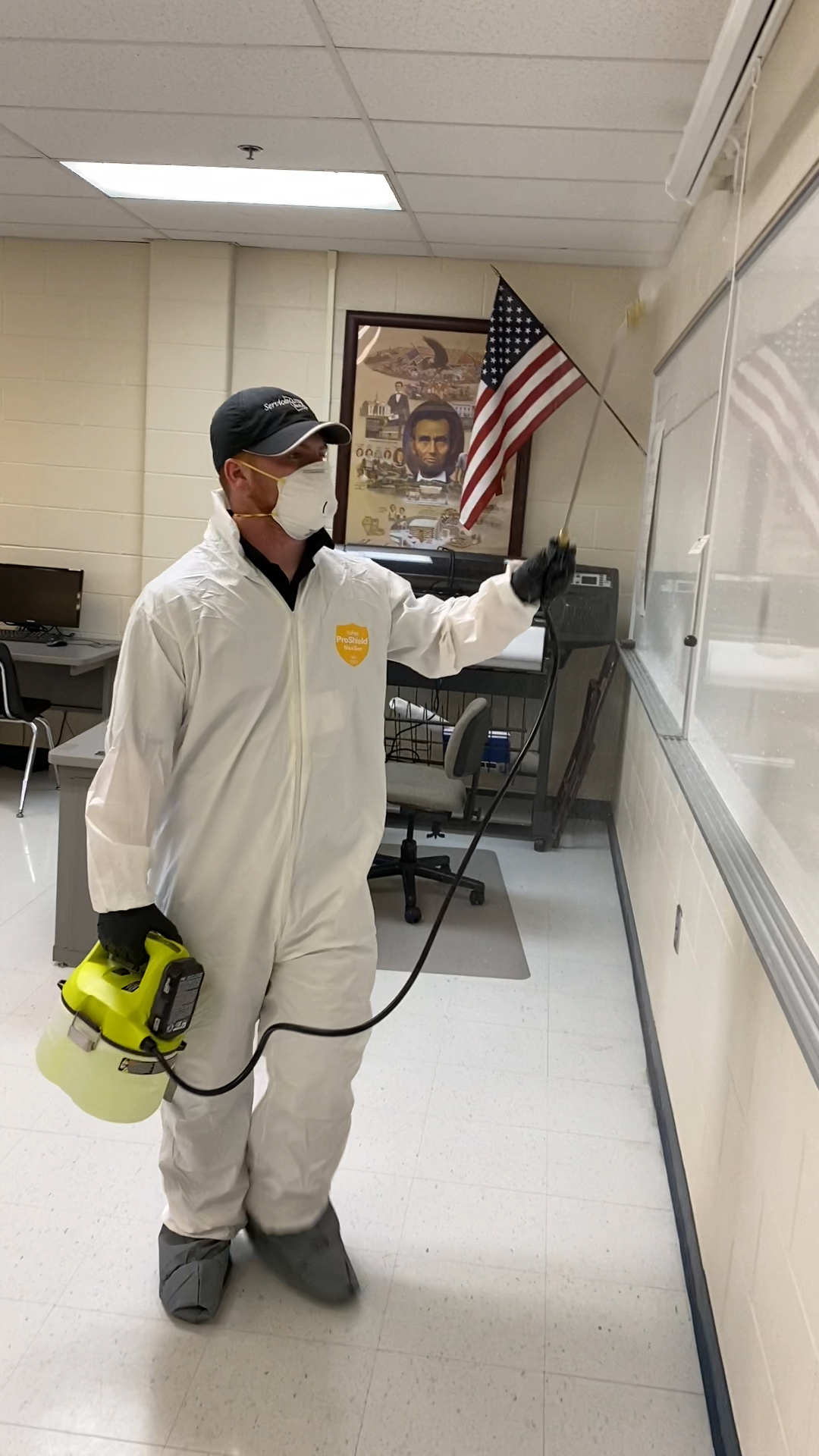
School disinfection. (Image courtesy of ServiceMaster Restore)
Many schools across the country will make decisions based on the risk of COVID-19 in their district. In Georgia, for example, the Georgia Department of Education has produced a reopening plan based on three levels of risk determined by the number of cases in each community. Level 1 is “low/no spread,” which means there is a low coronavirus risk and schools can reopen with normal precautions. Level 2 is “minimal/moderate spread,” which is an elevated risk. For districts with a minimal to moderate number of cases, schools are encouraged to adopt elevated mitigation and distancing strategies. Level 3 is the highest level of risk, “substantial spread,” with the recommendation that schools provide remote learning for as long as the high level of cases remain evident in their district.
If schools do open this fall, as many already plan to do, what cleaning protocols will be necessary to maintain a reasonable level of safety? Most will likely take a two-pronged approach: proactive disinfecting and secondary contact cleaning.
According to Morgan, some schools will consider it necessary to do a thorough deep cleaning and sanitization of all surfaces before school reopens. This proactive cleaning is both a practical idea and also a hedge against liability. Schools will want to assure parents and teachers that the school environment has been sanitized and is safe for students, but that’s just the start. They also will need to follow up with daily cleaning to prevent reinfection.
For deep cleaning, some schools may want professional help from an experienced cleaning service that uses EPA-registered products and cleaning techniques, and perhaps even electrostatic sprayers that assure more thorough coverage of all surfaces. Crews will first clean the facility thoroughly to remove dirt and grime, then sanitize all touchable surfaces making
sure that disinfecting products achieve adequate dwell times to kill bacteria and deactivate viruses.
Once teachers and students return to class, every room in the school could be potentially reinfected. It’s up to the individual school system to determine the level of cleaning it will do daily to help prevent the spread of coronavirus.
Daily spot cleaning by custodial crews will be essential to help break the chain of infection. Wiping high-touch surfaces with disinfecting cleaners will be a priority, but it is important that cleaning staff know the proper cleaning techniques, e.g., wiping only in one direction or in an “S” motion to prevent spreading germs, using microfiber cloths and mops to capture dust particles, and following product label requirements for application and adequate dwell times.
Some schools simply do not have enough staff to do spot cleaning multiple times a day and then provide a more thorough cleaning at night. In such cases, they may turn to outside vendors to augment their staff. Expect school administrators to educate themselves on cleaning and disinfecting before they interview outside janitorial services so they can ensure the company they hire is experienced and properly trained to do the job well.
Maintaining a clean, safe, and healthy environment for students also requires coordination and communication. Frequent, perhaps daily, inspection of the facility and written reports of cleaning procedures will help make sure everyone is focused. Check with your custodial team or custodial service provider (if you have one) daily to review their work and discuss potential issues. Remember the stakes are high when it comes to keeping schools clean, safe, and healthy. Attention to detail goes a long way.


ARTICLE from Cleaning & Maintenance Management - https://www.cmmonline.com/articles/reopening-schools-the-challenge-ahead

Friday, June 26, 2020

What Time Of The Day Should We Clean

What time of the day is the best time to clean?


Is the morning better or is the nighttime better?

What are the benefits of cleaning at each time?

Morning = Fresh start to clean and not be bothered.

Night = Nothing to be dirtied after cleaning and can have the location fresh for in the morning.


Article information from https://www.csginc.com/posts/night-and-day-cleaning/

Friday, May 29, 2020

Rats Taking Over

The pandemic has affected many aspects of modern living, from garbage and recycling pick up to public transportation.  Add pest control to the list.
The U.S. Centers for Disease Control and Prevention (CDC) warns that as a result of closed restaurants and other businesses, rats may be agressive as they hunt for new sources of food. Environmental health and rodent control programs should be prepared for an increase in calls. The CDC recommends that facilities seal all possible entries (rats can enter a building through a half-inch opening) and make sure garbage bins are tightly closed.

CLEANING MAINTENANCE MANAGEMENT

Tuesday, April 28, 2020

Improving Disinfection Outcomes with Electrostatic Technologies

It’s becoming more difficult for facilities to stay ahead of today’s rising public health threats and increasing demands for higher levels of disinfection. Managers and service providers are challenged with improving outcomes, yet in a limited timeframe without increasing budgets or staff. The advent of advanced electrostatic technologies offers facilities new ways to achieve greater efficiencies and better outcomes.

Newfound efficiency

Traditional disinfection methods can leave a large percentage of surfaces untouched. However, when electrostatics are used in place of—or in addition to—wipes, trigger sprayers, or mops, a single team member can disinfect the same area that normally required a staff of five. This newfound efficiency enables facilities to increase disinfection frequency, which is crucial to preventing the spread of emerging viral pathogens.
Electrostatic sprayers also achieve three times the coverage of a traditional spray bottle due to positively charged disinfectant droplets, which magnetically attract to and wrap around target surfaces. Not only can users expedite the disinfection processes, they also can eliminate virtually all infectious fungi, viral particles, and bacteria from every surface.

Electrostatic options

Over the last several years, electrostatic sprayer technologies have evolved significantly and are now easier to use for disinfection purposes. Types of equipment range from handheld sprayers and self-contained backpacks  to variations of rolling cart systems, or a combination thereof. Some versions are battery-powered, while others are corded, but both are designed to positively charge the liquid solution. Battery-powered sprayers remove the potential for cord-related accidents and allow freedom of movement without being tethered to an outlet. In the past, users questioned whether batteries were strong enough to deliver consistent electrostatic application compared to cords connected to a power source. However, today’s high-performance, portable sprayer technologies are more than powerful enough to coat every surface completely and evenly.
When comparing electrostatic equipment options, ensure they are ETL or UL certified by Nationally Recognized Testing Laboratories (NRTL) to confirm they meet the U.S. Occupational Safety and Health Administration’s (OSHA) safety standard requirements. Also make sure the equipment comes with clear guidelines to help staff use the system responsibly and with the proper disinfectant chemistries.

Electrostatic merits

Although electrostatic disinfection is on the rise, users are just beginning to realize its merits for improving disinfection outcomes. Many facilities are already seeing dramatic drops in labor costs and expenses due to faster disinfection times and triple surface coverage per ounce. In a matter of minutes, workers disinfect entire areas with just a quick pass of the electrostatic device over potentially contaminated surfaces.
Additionally, many safety benefits are associated with electrostatic disinfection processes. Applying chemicals in a more uniform and controlled manner removes the dangers of overuse and reduces waste and chemical use by as much as 60% per square foot.

Friday, April 10, 2020

Let's Show COVID-19 WHO IS BOSS!

During this recent outbreak, people are panicking about keeping everything clean, especially their workplaces.

Your commercial cleaning business has now become a necessity! Don’t let your business fail because you cut back on your advertising budget! This is the best time to start reminding your community that you can help.

Call someone you can count on 847-885-8181.

Tuesday, February 18, 2020

Expediting the Drying Cycle

Learn here and how the three aspects of drying can be most advantageous based on a timeline.


When it comes to water damage, understanding evaporation and how drying equipment is used can be beneficial for facility managers who do water restoration.


Below are things you must be aware of:

  1. Humidity
  2. Airflow
  3. Temperature
  4. Maximizing equipment efficiencies 


Article by IIRC - David Oakes

Friday, January 24, 2020

Workshop Attendees Fight MRSA With Training and Exercises

Members of a school’s volleyball team came down with Methicillin-resistant Staphylococcus aureus (MRSA), so school officials called in bio-response specialists to track the source of the infection and disinfect the campus. 
After the specialists cleaned and disinfected the volleyball courts, the locker rooms, and the showers, more team members came down with MRSA. So, the specialists turned their attention to the campus fitness center. After a thorough disinfection, the MRSA cases among the team ceased.
This scenario, although realistic, was actually an exercise in which attendees of a bio-response fundamentals training workshop presented by the GBAC, a division of ISSA, got the chance to try out what they learned. The all-day workshop, held this week at ISSA headquarters in Northbrook, Illinois, was created for individuals and facility service professionals seeking information and training on responding to disease outbreak situations, gaining skills in forensic cleaning and professional disinfection, and understanding the important role the cleaning industry has in public preparedness for infectious disease outbreaks.
Following a morning of training on germs; personal protective equipment (PPE); the methods and differences of cleaning, sanitizing, and disinfecting; and an overview of cleaning and disinfecting tools and equipment, attendees were ready to put their knowledge to test in the afternoon. They donned the appropriate PPE: paper coveralls, respirators, full-face shields, disposable gloves, shoe covers, hair covers, and even a helmet equipped with a cooling HEPA filter. They chose their microbial weapons—microfiber cleaning tools and a variety of electrostatic disinfecting sprayers available in hand-held, backpack, and wheeled cart models—and set off for the ISSA fitness center, which was masquerading as the volleyball team facility.
As GBAC trainers prompted them to start from the cleanest surface and make their way to the dirtiest, the trainees used their sprayers to mist the ceiling first, then the walls, all the fitness equipment, then lastly, the floors. “Gymnasiums are hard to disinfect as there are a lot of moving parts, a lot of areas for germs to hide,” said GBAC board member Dr. Gavin Macgregor-Skinner.
Staff reminded them to follow disinfectant dwell times, so if a product required a 10-minute dwell time and it was dry in seven minutes, it was best to rewet the surface.
After the class participants finished disinfecting the room, they made sure not to contaminate the room again with their equipment by cleaning the wheels and cord of a pull-along disinfectant sprayer. They also took care not to contaminate themselves, by following earlier instructions on the correct removal of disposable gloves as well as the rest of their PPE.  “You can practice removing disposable gloves while you are at home, watching tv,” Macgregor-Skinner suggested.
When one participant realized he had torn his coveralls, Macgregor-Skinner explained how he always carries duct tape for such emergencies. “Tears are realistic. Duct tape any rips; duct tape is your best friend,” he said.
Prepare your professional cleaning and restoration staff to become microbial warriors.


Article by Cleaning and Maintenance Management.